

RESOLUTION
Following the Expert Roundtable of the Atameken Business FORUM
“Investing in Kazakhstan: A Safe Haven for International Capital”
The Administration of the President of the Republic of Kazakhstan
The Government of the Republic of Kazakhstan
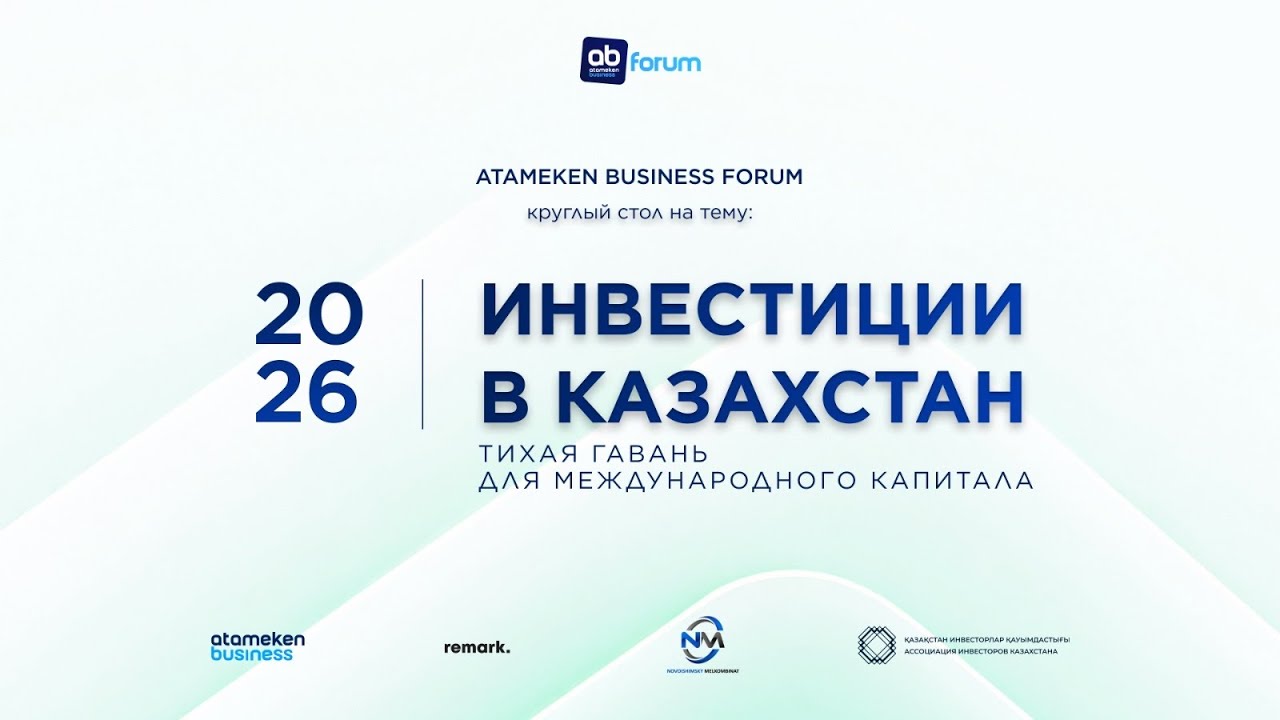
On June 3, 2026, an expert roundtable of the Atameken Business Forum was convened in Astana on the theme of “Investing in Kazakhstan: A Safe Haven for International Capital”. The discussion brought together representatives of the business community, the financial sector, industry associations, analytical centers, and the expert community.
During the discussion, it was noted that, despite the maintenance of positive macroeconomic indicators, structural imbalances in the economy of Kazakhstan are intensifying. Growth in certain sectors is driven primarily by state financing, while segments oriented toward domestic demand are showing signs of slowdown.
According to the expert assessments:
- Business activity, based on transactional data (Halyk Business Index), remains at a neutral level;
- The Business Activity Index compiled by the National Bank stood at 51.6 points (0.9 points higher than in April), while in the trade sector the index remained in the contraction zone at 49.7 points;
- Over the past 12 months, approximately 145,000 individual entrepreneurs ceased business activities, primarily in the trade, transport, and services sectors;
-
The following factors were identified as constraining business activity:
- – Decline in purchasing power: real incomes of the population decreased by 2.3% in 2025; the share of household expenditures on non-food goods and services declined to 39%;
- – Contraction in consumer lending: issuance of consumer loans decreased by 7.2%;
- – Changes in consumer behavior: the share of e-commerce in retail increased to 14.3%;
- – Changes in the tax regime;
- The share of e-commerce reached 14% and continues to grow;
- The wage bill increased by 12.8%, while companies’ revenues remained broadly stagnant;
- Low levels of transparency in the economy and business environment, as well as the absence of adequate incentives.
Forum participants noted that the existing economic growth model, based on commodity exports, fiscal stimulus, and investment attraction as an end in itself, is approaching the limits of its effectiveness. More than 70% of Kazakhstan’s exports continue to be accounted for by raw materials and metals, which maintains the economy’s dependence on external market conditions.
The discussion highlighted that institutional factors are becoming key constraints to further growth. According to a comparative analysis with OECD countries, Kazakhstan shows the largest gaps in the areas of “Rule of Law” and “Freedom of Investment”.
The forum survey indicated that the decisive factors for capital investment are:
1. Investor rights protection, judicial independence and regulatory predictability (23%)
2. Stability of the tax system, predictable monetary policy of the National Bank, and inflation control (23%);
3. Tax incentives, direct subsidies, and access to concessional financing for investment projects (17%).
Within their presentations and discussions, experts identified the following systemic challenges:
- • Insufficient protection of property rights and enforcement of contracts;
- • Persistent state dominance in certain sectors of the economy and distortion of market incentives;
- • High share of the commodity sector in the export structure;
- • Declining business activity in sectors oriented toward domestic demand;
- • Instability of the regulatory and tax environment;
- • Low transparency across a significant part of the business sector;
- • Poor coordination between central and regional government bodies in the implementation of investment policy;
- • Insufficient targeting of state support toward export-oriented and productive projects;
- • Persistent infrastructure constraints, including issues of water security and the development of modern digital infrastructure.
Experts noted that a country’s investment attractiveness is determined to a greater extent by institutional quality, predictability of government policy, macroeconomic stability, and a level playing field, rather than the volume of incentives and subsidies provided.
Special emphasis was placed on the issues of excessive state involvement in the economy, including active participation in the selection of investment projects and a high degree of involvement in their financing through various mechanisms. Forum participants also noted the need to shift from a quantitative approach to investment attraction toward a qualitative one, focused on the development of non-commodity exports, the creation of high value added, improvements in labor productivity, and growth in citizens’ welfare.
Recommendations and proposals of the expert community:
Forum participants developed a set of practical recommendations to improve approaches and policy priorities for enhancing the investment climate and the translation of investment growth into improvements in living standards.
Strengthen the rule of law as a key driver of investment attractiveness, including enhanced protection of property rights, guarantees of contract enforcement, increased judicial independence, greater transparency of public administration, and improved predictability of law enforcement practice.
Carry out a comprehensive review of legislation and secondary regulations to identify provisions granting targeted advantages, exemptions, and preferences to specific companies, sectors, or groups of market participants, followed by a transition to uniform and transparent regulatory rules (“We need to shift from personal relationships to impersonal rules. Personal ties do not create the scale required for a developed economy”)
Develop a long-term national investment strategy, defining which types of investments are a priority for Kazakhstan, what forms of support the state is willing to provide to investors, and what economic and social outcomes should be achieved through investment inflows. Priority should be placed on investments that generate high value added, support the development of non-commodity exports, promote production localization, and enhance labor productivity.
Reorient state investment policy from quantitative capital attraction metrics toward qualitative outcomes, including the creation of new production facilities, high-productivity jobs, income growth, technology transfer, and human capital development.
Ensure a gradual shift toward universal market-based regulatory mechanisms, while minimizing administrative intervention in price setting, export restrictions, non-market allocation of resources, and other measures that distort competition and weaken investment attractiveness.
Reduce reliance of investment policy on targeted incentives, subsidies, and individualized preferences, focusing instead on the development of a sound institutional environment and a level playing field for all market participants.
Introduce incentives to improve business transparency and develop the capital market, including encouraging companies to adopt more transparent corporate governance practices, expanding disclosure requirements, and enabling broader public participation in wealth accumulation and redistribution through capital market instruments.
Restore and strengthen transparency standards for legal entities by ensuring the publication of financial statements in line with international standards, including in the extractive sector, and by disclosing information on subsoil use, ownership structure, investment commitments, and the socio-economic impact of natural resource utilization.
Introduce the systematic use of artificial intelligence and big data analytics in public administration, including data derived from aggregated citizen requests submitted via the e-Otinish platform, to identify systemic issues, improve regulatory quality, reduce excessive administrative procedures, and expand the automation of public services.
Ensure the digitalization and automation of public services and regulatory and supervisory processes, based on a preventive approach aimed at addressing the root causes of citizen and business complaints, rather than reacting to their consequences.
Enhance coordination between central government bodies, regional authorities, and development institutions to ensure coherent investment policy, alignment with regional competitive advantages, and higher-quality selection of investment projects.
Develop a comprehensive enabling environment for living and doing business, including quality infrastructure, environmental sustainability, water security, public safety, livable urban conditions, and high-quality public services, thereby supporting the retention of human capital, investment, and domestic consumer spending.
Develop additional measures to support SMEs by reducing administrative and fiscal burdens, taking into account the closure of 145,000 individual entrepreneurs since the beginning of the current year. Based on transactional data, place particular focus on the mid-sized business segment oriented toward domestic demand, particularly in the trade, transport, and services sectors.
The development of a long-term fiscal policy, supported by legislative safeguards against revision over the medium term (5–7 years), would ensure predictability of business conditions. According to the expert survey, tax system stability, predictable monetary policy of the National Bank, and inflation control are among the most significant factors driving investment inflows into Kazakhstan.